
Bitcoin Is Laying New Rails In Africa
Welcome to THE 21st.
Every month on the 21st, this editorial does one thing: it looks at what is actually happening with Bitcoin across Africa, with the rigour the subject deserves and the directness the moment demands.
This February edition asks: what is the new intersection of Bitcoin and Africa today?
THIS IS NOT ABOUT ADOPTION ANYMORE. IT IS ABOUT ARCHITECTURE.
For years, Bitcoin in Africa meant: can you buy it, can you hold it, can you get your money out. That problem has been largely solved, and mostly by ordinary people who found ways around the banks rather than through them. The new problem is harder. It is about who owns the infrastructure underneath the settlement rails, the on-ramps and off-ramps, the custody and the compliance stack. That layer determines whether Bitcoin in Africa is a tool that Africans control, or a service they consume on terms set by someone else.
BOTSWANA & CONGO: WHERE BITCOIN BEATS THE BANK.
In January 2026, Borderless.xyz published rate data from 94,000 observations across 66 African currency corridors. Africa’s median stablecoin-to-fiat spread: 3%. Latin America’s: 1.3%. Asia’s: 0.07%. Economist Vera Songwe cited the figures at Davos. But the number that mattered was Botswana’s: negative 342 basis points. Bitcoin rails are cheaper than the bank there. Not theoretically, on real transactions in January. The Democratic Republic of Congo’s spread was 3,436 basis points, because one provider quotes one static rate against a parallel market with no competition. Botswana and Congo are separated by 2,000 kilometres and 34 percentage points. Competition built one outcome. The absence of it built the other.
SOUTH AFRICA — JOHANNESBURG
A Bitcoin Treasury Company That Actually Lends Money
Warren Wheatley runs a lending business. He also runs a Bitcoin treasury. In Johannesburg in 2026, those are the same company. Africa Bitcoin Corporation, formerly known as Altvest Capital, added 1.35 BTC to its balance sheet in February, bringing total holdings to 4.55 BTC. The case is not about price. By holding Bitcoin as a reserve asset, ABC accesses international capital at rates no competitor relying solely on African markets can match. That cheaper capital funds loans to small businesses. Wheatley presented the model at the Digital Asset Treasury Conference in New York on January 27, 2026. Africa’s first publicly-listed Bitcoin treasury company, and it is lending to African entrepreneurs.
March 1, 2026, SARS Starts Watching.
From March 1, South Africa’s tax authority SARS enforces the global Crypto-Asset Reporting Framework. Every crypto service provider with a South African connection must collect and submit detailed user and transaction data, automatically shared with tax authorities internationally. South Africa left the FATF grey list in October 2025. This is the follow-through. For traders who have not declared Bitcoin activity, the window closed. For the broader ecosystem, it signals something useful: South Africa is building the regulatory infrastructure that serious institutional capital requires before it moves. Legitimacy has a cost. This is it.
Women are still Sidelined in 2026.
Her Husband Died. His Brothers Took Everything. This Is the Baseline.
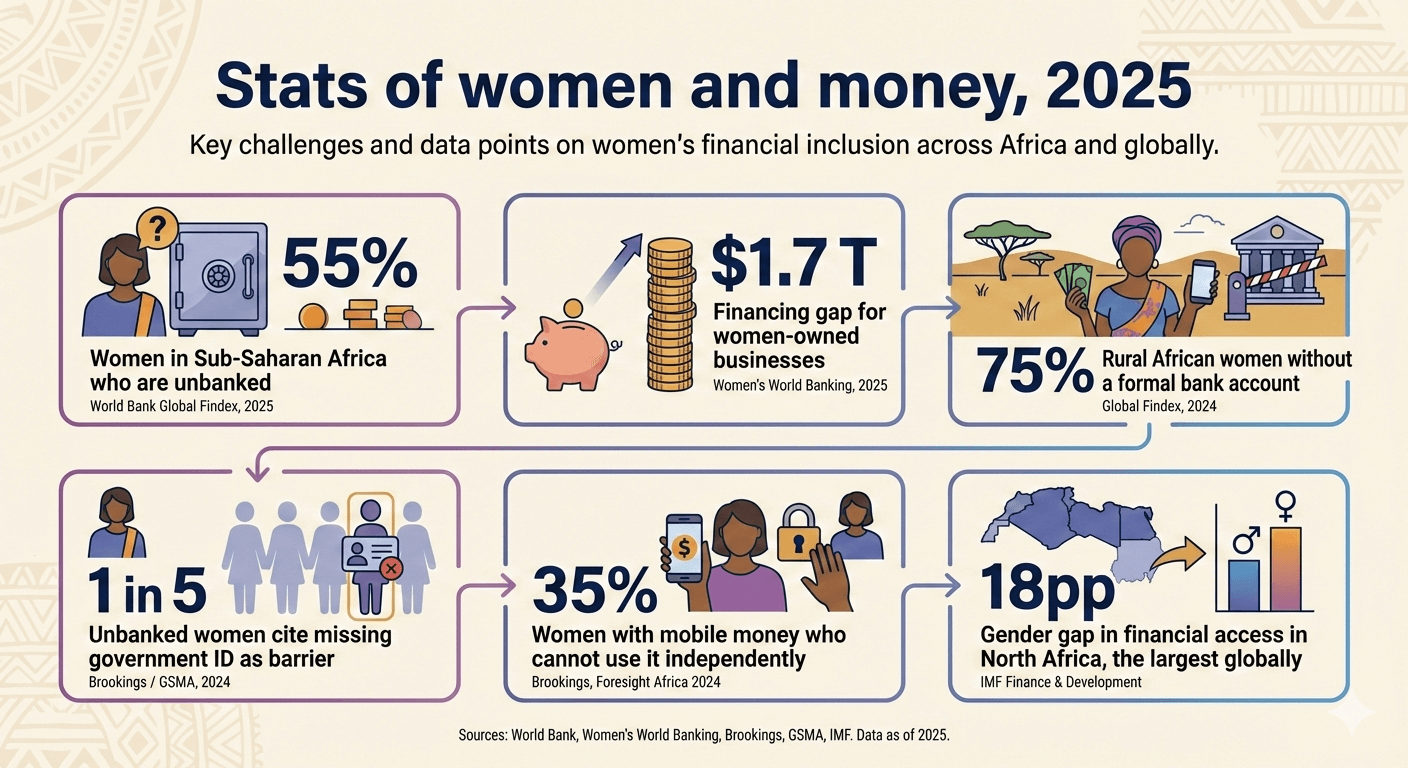
A widow in Kakamega, Kenya lost her husband’s land, home, and business to his male relatives. Kenya’s Law of Succession Act defers to customary law on agricultural land. Customary law did not recognise her. Human Rights Watch documented the same pattern in Malawi, Mozambique, South Africa, Tanzania, Zambia, Zimbabwe. In 44 countries, widows and widowers still do not inherit equally. The six numbers below are not background. They describe the ground that every Bitcoin product in Africa is built on, whether the builders know it or not.
Closing Relection:
A few years ago, Bitcoin infrastructure in Africa was a promise. Today, it is a balance sheet entry in Johannesburg and a corridor dataset that shows where work is done and where it has barely started. That is real progress. It is still not enough. Nearly 80% of Africa’s population has not embraced Bitcoin. That is the number that measures whether any of this truly matters.
Thank you for being part of our journey.
